![]() | |
|
|
Ayurveda By Troy Maddux and Diane Donovan, Ayurvedic Institute
Like many people, "Rita's" life is filled with activity. A usual day is one that includes long hours working in an office that is always busy. Rita sits at her desk, talking on the phone or working at the computer, often late into the evening. She likes her job, but lately she just hasn't had the energy to perform well. Some-times she feels anxious about impending deadlines and the work that must be completed, and sometimes she feels listless and lacks the energy needed to complete her tasks. A friend told Rita about Ayurveda, the ancient healing system of India. Rita was intrigued. What appealed to her was the common-sense approach of balancing one's life by eating proper foods and making simple lifestyle changes, such as sitting down to eat in a relaxed manner, instead of eating while driving or talking on the phone. These small changes can help the body with digestion of food and the mind with "digestion" of thoughts and emotions. According to the teachings of Ayurveda, indigestion at the physical or mental/emotional level can create toxic conditions in the body and mind, resulting in a life that is antagonistic to overall well-being. Rita was particularly interested in the cleansing process known as Pancha Karma, an Ayurvedic program designed to cleanse the body of toxins lodged in the deep connective tissues of the body. When Rita decided to start a new, healthy lifestyle with a newly cleansed body, she decided to visit the Pancha Karma clinic at the Ayurvedic Institute in Albuquerque, N.M. The following describes the first day of Rita's experience at the Ayurvedic Institute, and what others might experience as they venture into the world of Ayurveda. What
is Ayurveda? Earth.
These five elements give rise to the three biological doshas: vata, pitta
and kapha. Abhyanga The treatment starts with her two therapists standing beside the table on either side of Rita. They hold hands, then each takes one of Rita's hands. As the three connect they become a team which will work together for the next week to harmonize and balance Rita's doshas (see box pg. 19). One therapist moves to Rita's head while the other goes to her feet. After a moment of meditation to quiet their hearts and minds, the therapists simultaneously perform polarity therapy moves, resting their hands on Rita's head and ankles. This moment of centering helps the three leave behind the work-a-day world and be more present during the treatment. Now the oil treatment begins. The oil used on Rita was chosen especially for her prakruti, or constitution, and her vikruti, or imbalance of constitutions. Rita's vikruti is assessed by an Ayurvedic practitioner who has many tools to determine her particular imbalances. Some of the common diagnostic methods include reading Rita's pulse using the index, middle and ring fingers. If her pulse is slithering like a snake, then her vata is high. If it is jumping like a frog, then pitta is high, and a smooth pulse - like a swan swimming on a lake - indicates a kapha pulse. These analogies from the natural world are simple ways of expressing some of the complex and subtle pulse differences which can be felt under the fingers of a skilled practitioner of Ayurveda. There are many other ways of determining what is going on with Rita's constitution. Her tongue can be examined for signs of toxins in various parts of her body or for stresses in various tissues, organs or doshas. A skilled practitioner can read the lines on Rita's face and palpate, or tap, her tissues feeling and listening for body cues as to her current condition. Careful listening to Rita's concerns and complaints, as well as her answers to specifically crafted questions about her life and lifestyle, rounds out the assessment of Rita's physical, mental, and emotional condition. If Rita's pitta is high she is given a cooling oil (cooling and warming refer to the energetic properties inherent in the oil and not the actual temperature of the oil which is kept comfortably warm throughout the massage) such as sunflower to balance pitta's fiery nature. If Rita has high kapha or vata, then a heating oil such as sesame oil is used on her to warm up these cooler doshas. If Rita has a combination of doshas affected, then the oils will be combined to match her current condition. Rita's traveling and working late nights makes her vata high. For this reason, it is decided that sesame oil is best for her. Netti
Massage and Karna Puran Rita has already spoken with one of the Ayurvedic practitioners at the Ayurvedic Institute who has checked with her to be sure she has no ear conditions or infections which would keep her from getting oil in the ear. Rita has healthy ears and a bit of trepidation the first time the oil is poured into one of them. As the warm oil flows in her ear she feels a new, pleasant sensation. As the warm oil counterbalances the dry and cold influences in her ear, Rita's trepidation vanishes. After massaging Rita's outer ear and the side of her head and neck, the therapist gently turns her head to the opposite side to drain the first ear and repeat the process on the opposite ear. After both ears have been worked on and emptied of oil, her face massage begins. Face
Massage, Marma Points, Nasya After her face massage, Rita's therapist asks her if she has ever had nasya before. She shakes her head no and her smooth relaxed brow starts to furrow just a bit with this new unknown. Her therapist smiles and explains that she will get five drops of oil (one for each of the Ayurvedic elements: Ether, Air, Fire, Water, Earth) placed in each of her nostrils. After the oil is given, Rita gives a big sniff, and a gentle massage along the sides of her nose ensures uniform application. Ancient Indian texts say that the nose is the door to the brain and consciousness, and keeping the passages balanced can improve concentration and restore balance to the brain. Rita smells the exotic mixture of oils in the nasya, and recognizes the penetrating eucalyptus, but can't quite pick out the other scents from this mixture which includes oils of basil, sandalwood, lotus, olive and coconut. While one therapist has been working on her head, Rita's feet have been thoroughly oiled and massaged by the second therapist, who also worked on several important marma points. In addition to her regular oil, some castor oil was applied to her heels for its emollient action to soften the tough, dry skin there. This is a classic vata sign, showing two of vata's attributes - dry and rough. Working
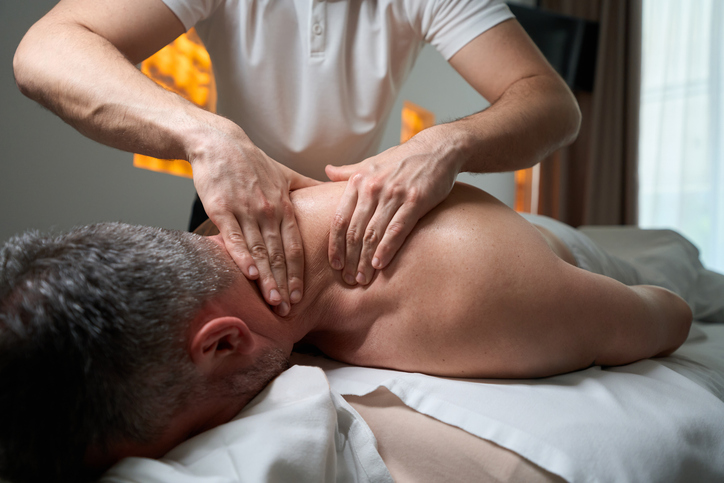
with the Body After the front of her legs are finished, Rita's arms are massaged. As on the legs, each therapist takes one of Rita's arms and matches the timing, pressure and speed as they spread the generous helping of oil with strokes that traverse the length of her arms. Matching circles on Rita's shoulders are followed by gliding strokes along her upper trapezius muscles from shoulder to occiput and back, then milking strokes pulling across her shoulders from the base of her neck to the tip of her shoulder. Rita's mind drifts up from its reverie long enough to think that "the only thing better than a shoulder massage is getting both shoulders massaged at the same time." The forearms are worked next with matching effleurage and thumb circles. Rita's arms are held above her head and a trail of oil is poured on both sides from elbow to shoulder and then along the lateral torso to her hips. Long gliding strokes follow this trail of oil, come back, and end with circles on her elbow. Rita's hands are next, starting with her fingers which get circles around the knuckles, followed by pulling strokes at the fingertips. The circular strokes at Rita's joints are typical of this massage which is calming to the constant movement of vata. Vata, being made of the Ayurvedic elements air and space, can accumulate anyplace in the body where there is a space. The spaces in joints are typical places for vata to accumulate. The circular massage with warm oil over the joints helps balance these forces. Thumb circles on Rita's palms finish the hands, leaving only Rita's abdomen and chest yet to be oiled on this side of her body. After Rita is properly draped, oil is spread across her abdomen and chest. One therapist works on Rita's chest and marma points for the heart and lungs, while the second therapist works her abdomen and marma points for her liver, spleen, intestines and other abdominal organs. Ancient texts in Ayurveda say that the abdomen is the meeting point for the 72,000 nadis or "energy nerves" which carry energy throughout the body - a concept somewhat similar to the meridians of Chinese medicine in that they are channels which carry energy, but have no physical structure in the body. Turning Rita onto her stomach, the therapists squeeze a trail of oil along Rita's lower limbs and again they spread the oil with matching strokes. The backs of Rita's lower limbs and gluteals are massaged with long effleurage strokes, thumb circles and hand-over-hand friction to warm the tissues and help oil penetration. Some of the long strokes, punctuated with marma points, are the stroke up the thigh with a stop in the middle for "oorvee" which is a marma point to send healing energy to the bladder, colon and reproductive organs. The next marma point is at the gluteal fold, at a point called "sphig," which helps with sciatica, leg pain and the colon. After her lower limbs are finished, Rita's back is exposed and oiled and, for the third time in the massage, Rita's therapists work independently for a short time. One therapist works her shoulders and upper back while the other works on Rita's lower back and sacrum. After a few minutes of spreading the oil and kneading and warming the tissues, her therapists again commence their synchronized three-person dance. Thumb-stripping up both sides of the spine is followed by matching circles up both sides of the back. Then each therapist glides an elbow along Rita's erector spinae muscles at the laminar grooves of her spine. More large circles precede thumb strokes which follow the contour of Rita's scapulae, at times deep enough to affect her subscapularis muscles. Thumb circles around both scapulae finish this area and her therapists finish her back with large circles and long, hand-over-hand, effleurage strokes. After the massage of Rita's back is complete, her therapists each place one hand, one on top of the other, on the area behind Rita's heart and the other hand lies flat against each of Rita's hands. This polarity move is held for a short time, then followed by two additional moves, ending with hands on her sacrum and feet. These moves help balance Rita's energies and leave her feeling like she is floating in a dream-like state. Rita must once again emerge from this blissful state, enough to turn back over. The ending movements of this massage have the therapists at the head and feet again, as in the beginning. The therapist at the head massages Rita's face, neck and shoulders a bit more and puts some more jatamamsi oil on her temples and forehead. As the sweet, earthy smell comes back to her again, Rita feels grounded and content. The massage is followed by polarity moves which include cradling Rita's head and balancing her head and abdomen. While the therapist at the head holds hands on Rita, the therapist at the feet is holding Rita's knees, ankles and feet. The polarity moves are followed by a prayer. These provide a gentle closure to the treatment and calm energies which could be disruptive to the healing process. Rita is now calm, relaxed, and after she rests for a few minutes, she will go to the next step in the process, "swedan." This is therapy using heat to warm Rita even more and allow the oil to penetrate more deeply. Swedan As the week-long therapy progresses, the steam will continue the process of liquefying and mobilizing toxins being released from deeper and deeper tissues. An old analogy in Ayurveda is removing honey from a bowl. The honey is sticky, just as toxins in the body are. If you oil the bowl, it will make it much easier to get the honey out. This process is also facilitated by heat. As Rita sits in her steam bath, toxins are brought to the surface with the sweat beading up on her skin, and deeper toxins make their way to the digestive system to be eliminated by the actions of pancha karma. After a short time in the steam room, Rita is ready to begin another journey with oil, one called Shirodhara. Shirodhara As Rita stood in the shower she thought of her Shirodhara experience and how it was a nice ending to the series of profound new sights, sounds and experiences she embraced today. It was a magical journey, and she had four more days to go. Ayurvedic
Oils Oil also prevents dryness and many of the effects of premature aging. The many benefits of oil, according to Ayurveda, include: increased suppleness, softened skin, dispersement of heat evenly throughout the body and a reduction of stress by calming the nervous system. Many oils are used in Ayurveda. Below is an outline of which oils are best for a particular aggravated or dominant dosha: Vata - Use sesame oil or castor oil. Pitta - Use coconut oil or sunflower oil. Kapha - Use mustard oil, olive oil, sunflower oil or almond oil. Doshas: Harmonizing Vata, Pitta, and Kapha A combination of space and air creates vata, the principle of movement. Vata represents all mobility in the body, from how many thoughts one might have in a minute to how efficiently food moves through the intestines. The vata quality is responsible for joy, happiness, creativity, speech, sneezing and elimination, just to name a few functions. The biological combination of fire and water creates pitta. Pitta governs digestion, absorption and assimilation of food-stuffs and transforms the food into energy. Pitta represents the fire principle in the body. Literally everything that enters the body must be digested or "cooked" - from the sight of a new moon to a wild strawberry popped into the mouth. Some foods, like rice, need external cooking, as well, before the body fire can begin digestion. Along with the gastric fire, pitta includes enzymes and amino acids which play a major role in metabolism. Just a few of pitta's responsibilities are regulating body heat through chemical transformation of food, giving one an appetite, vitality, learning and understanding. Earth and water create kapha, the constructing, cementing material of the body, which includes protein. Kapha comprises all our cells, tissues and organs. Kapha molecules tend to stick together to form compact masses and give the body a chubby shape. Lubrication of joints and organs, strong muscles and bones, cellular secretions and memory retention are all part of kapha's water duties. Kapha gives strength, stamina and vitality. Pancha
karma This "centripetal motion," from the periphery to the center of the body, is done through the action of massage, sweating therapy and a special cleansing mono-diet. Once these toxins are mostly confined to the GI tract, they are flushed out through various methods, Rejuvenation can begin after purification and usually consists of special herbal formulas, specific for an individual's constitution. Training
in Ayurvedic Massage Troy Maddux is a nationally certified, licensed massage therapist in New Mexico. He received certification as a Natural Therapeutics Specialist from the New Mexico School of Natural Therapeutics in 1995. He has offered abhyanga-style massage at the Ayurvedic Institute since 1995 and will start teaching anatomy and physiology in November. He also teaches biology, botany, chemistry and anatomy and physiology at the Southwest Acupuncture College in Albuquerque. He has a private massage office in the North Valley Acupuncture Clinic in Albuquerque and has an M.A. in biology. Diane Donovan is the Panchakarma Department Assistant Manager at the Ayurvedic Institute and a graduate of the Ayurvedic Studies Program. Donovan also works as a massage therapist using Ayurvedic massage techniques in the Panchakarma Department at the Ayurvedic Institute and in her own private practice. The Ayurvedic Institute was founded in 1984 by Dr. Vasant Lad, Ayurvedic physician and principal instructor. The Ayurvedic Institute was established to promote the traditional knowledge of Ayurveda. In support of this, the Institute also offers programs in the sister disciplines of Ayurveda: Sanskrit, Yoga and Jyotish (Vedic astrology). Panchakarma seminars taught at the Institute include teachings on Ayurvedic massage. For more information on Ayurveda and Ayurvedic massage, please contact the Ayurvedic Institute at 505/291-9698; e-mail at pk@ayurveda.com or ddonovan@ayurveda.com. Selected
Readings Book List Ayurveda: The Science of Self-Healing. Lad, Vasant. Lotus Press: Santa Fe, 1984. Ayurvedic Cooking for Self-Healing. Lad, Usha and Dr. Vasant. 2nd ed., The Ayurvedic Press: Albuquerque, 1997. Prakruti: Your Ayurvedic Constitution. Svoboda, Robert E. Geocom Limited: Albuquerque, 1989. Secrets of the Pulse: The Ancient Art of Ayurvedic Pulse Diagnosis. Lad, Vasant. The Ayurvedic Press: Albuquerque, 1996. The Book of Ayurveda: A Holistic Approach to Health and Longevity. Morrison, Judith H. New York: Simon & Schuster Inc., 1995, A Fireside Book. The Hidden Secret of Ayurveda. Svoboda, Robert E. Pune, India, 1980; 2nd ed., The Ayurvedic Press: Albuquerque, 1996. The Yoga of Herbs. Frawley, David, and Vasant Lad. Lotus Press: Santa Fe, 1986 Please close window after
reading. |
| ©2002 Associated Bodywork & Massage Professionals. All rights reserved. No portion of this website may be reproduced, stored in a retrieval system, or transmitted in any form by any means, electronic, mechanical, photocopying, recording, or otherwise, without prior written permission from ABMP. |