![]() | |||||||||
|
|
Collision and Consciousness By Stephanie Mines
We are more exposed and vulnerable in our cars than in any other daily activity. Our lives rest in each other’s hands. We ride in our vehicles through time and space, largely in denial of the dangers surrounding us, thinking random thoughts, reliving the past, having future conversations or just daydreaming, disconnected from our bodies. Then a collision happens and life is dramatically altered. Survivors of serious automobile accidents are highly prone to developing post-traumatic stress disorder (PTSD) and phobias, as well as chronic pain. Blanchard and Hickling, authors of After the Crash, say motor vehicle accidents are “the single leading cause of PTSD in the American population.” They report that in some studies, both in the United States and internationally, nearly 100 percent of survivors developed PTSD. These survivors are also at substantial risk for headache syndrome, temporomandibular joint syndrome (TMJ), neck and back pain, thoracic outlet syndrome (TOS), prolonged myofascial pain and fibromyalgia. Robert Scaer, M.D., is the director of Rehabilitation Services and Pain Management at Boulder Community Hospital in Colorado and author of The Body Bears the Burden. He writes, “The remarkably persistent pain and disability seen in many whiplash patients occurs much more rarely in recreational activities or sports injuries where the individual is subjected to velocity forces of severity comparable to low to medium velocity motor vehicle accidents.” Scaer’s descriptions of the entrapped pain patterns in the bodies of vehicular accident survivors point to the complexity that is often aroused by the accidents. In many cases the accidents kindle historical shock that is physiologically and structurally latent, the unresolved residue of past experience. Minor traumatic
brain injury is another common outgrowth of motor vehicle accidents
and of whiplash in particular. Any kind of shock at the time of the
accident, including mental and emotional shock, may be sufficient to
alter brain chemistry and even structure, through the conditions of
the event or the forces of velocity. “Studies have shown that
actual head impact is not necessary to cause axonal shearing,”
Scaer says. The
Role of Neurotransmitters Basically neurotransmitters are the electro-biochemical messengers that cross the synapses between the nerves. They carry information between the body and the brain. They identify pain and pleasure and promote appropriate responses, such as moving away from pain and appreciating and moving towards relief. They activate the body’s resources to self-heal. Chronic pain depends on neurotransmitter confusion. In other words, chronic or persistent pain requires that neurotransmitters malfunction and fail to provide the resources that are within the body’s own neurochemistry. External stimulus is therefore needed to reactivate, recharge and excite neurotransmitter re-regulation. Touch and language do this readily. Painkillers and anti-depressants often fail to meet the needs of motor vehicle accident survivors. An estimated 33 percent, according to Scaer, still have PTSD two years post-accident and 44 percent of these patients slip into a major depression. Chronic pain frequently continues throughout the life of survivors, and often they just learn to live with it. Obviously the neurotransmitter re-regulation required for healing is not being sufficiently activated by chemical intervention. It is my observation the most likely environment for allowing the discharge of adrenaline is one in which subtle touch is applied. In creating a safe space for release, including sounds and movement (like the shaking and trembling that organically distributes stored adrenaline), the bodyworker provides a simple and necessary opportunity. When this sounding and trembling happen without embarrassment or restriction, neurotransmitters, freed of the repression of control, reorganize, allowing the body’s own endorphins to do the healing work. The slower pace of energy medicine creates the processing space for the survivor to differentiate between the past and the present. This sorting is an automatic function of the nervous system. The subtle therapies I have used are Jin Shin Tara and cranial sacral treatment. Because these systems follow the natural rhythms of organic, internal recovery, they encourage spontaneous neurological reorganization. It is the job of the amygdala, a small almond-shaped structure in the middle or mediating brain, to discriminate between the emotional memory of past trauma and current experience. Without the opportunity to sort past from present, the amygdala is conditioned to attach new shock to old, stripping the recovery process of its potential simplicity and instead layering it with additional repression. For this reason, bodyworkers need to have the skill to use simple words and phrases to suggest, and in some cases to initiate, this sorting process. Language can readily redirect the client to their present health, attuning them to how well they have survived and what they have not lost. Rushing the healing process, demanding that it conform to pre-determined time frames and stripping it of its individuality creates a pressure and distortion that inhibits the amygdala and, in fact, may increase trauma and add more neurological shock. The
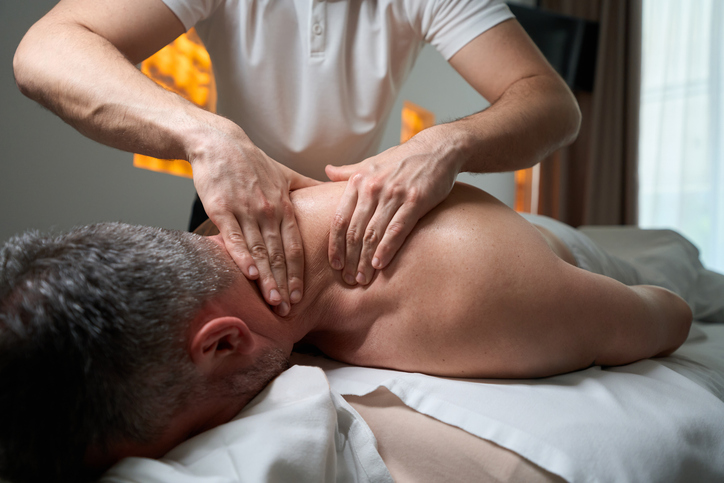
Research To counter this, I would like to focus on two stories derived from my experience in which PTSD, although expected, was not the outcome of the accidents, and anti-depressants were not required. In addition, the continued use of anti-inflammatory medication and painkillers was not necessary, despite the severity of the accidents. I would like to emphasize these stories do not include real names and the information reflects a synthesis of many cases. Jeanette However, despite the prognosis, the magnitude and rate of Jeanette’s recovery astounded people. She appeared to have been enhanced by the accident rather than destroyed by it. She carried no bitterness or resentment. She fought the insurance companies strongly and clearly whenever she had to. In addition to Jeanette’s proactive and realistic attitude toward the insurance companies, she also knew what was and was not helping her recover. Jeanette knew massage and energy treatments were making a difference, so she pursued them weekly. She also recognized the love and support she received from friends and family and acknowledged how central this was to her healing. She eventually became a significant spiritual resource to her friends because of what her encounter with mortality taught her. Jeanette walked away from the accident with the gift of life. Jeanette’s massage therapist was extremely sensitive to the magnitude of her client’s recovery. One session in particular illustrated their co-partnership in the healing process. Jeanette had just discovered that it would be impossible to save her eye, that she would need to have a false eye, and that it would probably be at least a year before the operation necessary for the replacement of her eye could occur. She was alone when she got the news, but luckily her massage was scheduled shortly thereafter. Jeanette lay back on the massage table and immediately sighed deeply. The therapist’s hands felt safe. They moved around Jeanette’s eyes, gently circulating and occasionally pressing on the bones around her eyes. As she sank deeper into the soothing rhythms of touch, Jeanette forgot that her left eye didn’t really work and eventually would be taken from her completely. The therapist’s hands were sweeping now, stroking the skin around her eyes. It felt as if a bird was slowly flapping its wings on her face. Then Jeanette recalled all she had hoped would take place. For weeks before her departure on the fateful trip with her fiance, she had seen, in her mind’s eye, the moment when she would stand with her beloved in front of her parents and announce their engagement. She had seen the look of pleasure on their faces. Jeanette was in her 40s. This marriage was coming late, and her parents had not been successful in hiding their concern that their daughter would become a spinster. Not only was Jeanette glad to relieve them of their worry, she was also genuinely in love, and proud of who she had chosen. The picture Jeanette had imagined for so long dissolved, and so did Jeanette. It was as if her massage therapist was actually extracting all the memories Jeanette had carried in her internal vision and then shoved away in the back of a cave inside of her. And, of course, there was the loss of the eye itself, which she remembered now, almost as if hearing about it for the first time. Jeanette remembered how she loved detail. As a designer, detail was her forte. Everyone knew that. Being precise was her gift. And that gift had been stolen. The tears streamed down Jeanette’s face and she began to moan. This moaning was strangely satisfying, an audible accompaniment to her feeling, a way of being present to herself, a way to come out of hiding, to stop denying all she had lost. Her massage therapist just said, “Yes, yes,” very softly but with undeniable compassion. When Jeanette lay by herself in the room at the end of the massage, she felt relieved and prepared to face the future. When her massage therapist met her outside, Jeanette smiled at her and said, “Thank you.” The tears had lightened Jeanette’s burden, and it added to her relief that her grief had been compassionately witnessed. The space to uniquely and creatively express her grief awakened the neurotransmitter dopamine and this stimulated security and comfort. As she moaned on the table, she lost track of the time. The moaning itself was the central event. She was completely focused on her own expression and no one stopped her, no one criticized her, no one judged her. The freedom allowed the expression to deepen, and in that permission to be, dopamine was aroused. Jeanette knew she would sleep peacefully that night and she would wake in the morning prepared to deal creatively and proactively with her transforming, evolving life. Roberto “I was in a car accident,” Roberto answered, deepening the furrow in his forehead. “Are you OK?” she responded, her eyes scanning his body. “No,” he declared, his anger evident. “I can’t move my neck and I have a terrible headache.” “Lie down,” she said. “I’ll treat you.” Of course Maria knew this was not Roberto’s first accident. In fact, she had met him because of a more serious accident when he had lost his spleen and his right kidney. She was working in the hospital where he was recovering, and they fell in love. Maria knew too most people who experienced a life-threatening accident, such as Roberto’s, would have a life of pain and depression. As a massage therapist, she had seen and heard that outcome many times. But not so with Roberto, because she had been treating him with bodywork, energy healing and massage. But this second accident had come as a real surprise. Roberto was furious at the woman who caused it, and he was even more furious that he couldn’t move his neck without feeling pain. Maria positioned
herself first at his side. She held the base of his cranium and the
tip of his tailbone. Her touch was light, but stimulating and soothing
at the same time. Roberto involuntarily breathed much more deeply. He
could feel the slowing of his heartbeat. His anger shifted, subtly but
definitely, from frustration to disgust, and then to acceptance. He let go, and then he sighed again. As she held the sides of his occiput, he said, “The fog is lifting.” “You’re going to be OK,” Maria said. “This is not like the other accident. Your life is not in danger. You are going to be just fine.” Roberto’s head got even heavier. He sighed yet again, realizing he had been worrying he would lose yet another organ or he would be disabled in some way, as he feared before when he lay in the hospital month after month. Maria moved her husband’s head gently from side to side and found no restriction. Whatever was impeded had melted. “You should probably call your chiropractor,” Maria suggested when Roberto felt ready to stand up and experience the freedom of movement he had just reclaimed. Roberto visited his chiropractor the next day. The doctor was amazed he didn’t find any signs of whiplash. “No one recovers this fast,” he said. “They do when they have a wife like mine,” Roberto smiled in response. What created
the atypical recovery for Roberto? The answer rests in the following
formula: Revolution
on the Frontier I am talking about a nonviolent revolution, as, I posit, all revolutions that protest violence must be. The consumer holds the most powerful position in this movement. It appears that insurance companies and the medical establishment have the power of authority, but in fact they have no power unless the consumer hands it to them. This is a revolution of consciousness, originating from our need to restore to ourselves the right to live and be well. This birthright motivates me to share the magnitude of services available to prevent prolonged and chronic injury after accidents occur. But I am also motivated to encourage us to open our eyes to our own driving behavior, especially driving while intoxicated. Getting into our cars and going places has become a form of unconscious communal living. The revolution on the frontier demands that we wake up to what we know about our behavior and our well-being. It is my hope to change this unconscious behavior that causes needless suffering for so many and great profit for so few. Portions of this article are excerpted from Stephanie Mines’ forthcoming book, We Are All in Shock: How Overwhelming Experience Shatters You and What You Can Do About It. Stephanie Mines, Ph.D., is the originator of the TARA Approach which combines touch and language for the resolution of shock and trauma. Jin Shin Tara is its hands-on component. Contact Mines at The TARA Approach for the Resolution of Shock and Trauma, 2910 County Road 67, Boulder, CO 80303; 303/499-9990; www.tara-approach.org. Resources
Please close window after reading. | ||||||||
| ©2003 Associated Bodywork & Massage Professionals. All rights reserved. No portion of this website may be reproduced, stored in a retrieval system, or transmitted in any form by any means, electronic, mechanical, photocopying, recording, or otherwise, without prior written permission from ABMP. |