![]() | |||||||||||||||||||||||
|
Seated Massage By Mary Kathleen Rose
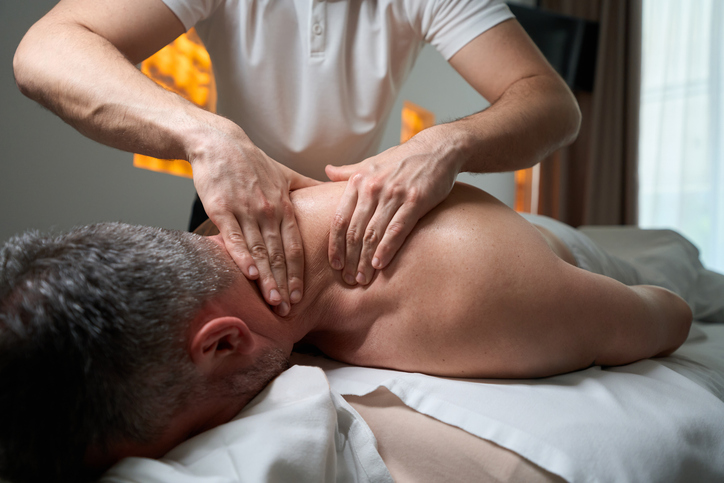
Wow!” Linda said as she stood up from the chair and slowly walked across the dining room floor. “My headache is gone. Thank you!” Had I given a complicated headache treatment or finished a full-body massage session for Linda? No. I had just given her a five-minute, impromptu seated massage while she sat on a kitchen chair. She is the caregiver for one of my elder, homebound massage clients and had been complaining of a headache, so I offered to give her a quick seated massage session. Over the years of my massage practice, I have often been impressed with the effects of a few minutes of well-placed touch with the client in a seated position. When I was in massage school in 1984, we learned a seated massage routine in shiatsu class that was often used as a quick warm-up. The recipient sat on a cushion on the floor, and the practitioner stood, knelt, and/or sat behind the person to massage their shoulders, neck, and back with a combination of presses, squeezing movements, and percussion. Even then, I was pleasantly surprised with the change that could happen in a short amount of time, as the recipient relaxed and let go of tension. A short, seated massage session can be likened to a full, deep breath, in which the receiver of touch is allowed to exhale spent energy from the body, and is rejuvenated by the expansiveness of fresh inspiration. Practiced without lotion or oil on a client who is fully clothed, seated massage provides a break in the day’s routine that can help reset the perception of one’s life with all its myriad physical, mental, and emotional challenges. Massage Chair is Not for Everyone • Circulation in the legs — The elderly, and those with compromised circulation in the legs, do not benefit by having their lower limbs compressed against the incline of the leg rests on the commercial massage chair. • Breathing — Those with compromised breathing, due to age, asthma, emphysema, or other respiratory disorders can be uncomfortable leaning into a face cradle, as it can impair breathing and put undue pressure against delicate tissues of the face. The chest support also inhibits breathing for some people because of pressure on the ribcage. • Neck and head injuries — Those with neck or head injuries often find the face cradle uncomfortable as it provides no real support for the neck. In this position, pressure against the upper back, neck, and head can aggravate neck pain or contribute to headaches or dizziness. • Accessibility — For some people, the massage chair is simply inaccessible. Clothing may make it difficult to get into the required position. Or issues of balance or flexibility can make it awkward to sit in the chair. For a very short person or child, it can be difficult to adjust the chair to the right body proportions. Seated and Upright • Posture — The vertical seated position encourages proper alignment of the client’s vertebral column. The head is over the shoulders, the shoulders are over the rib cage, and the rib cage is over the pelvis, which is supported comfortably by the chair seat. Many different relaxation and meditation practices promote this alignment to optimize deep relaxation. I often place • Breathing — When sitting upright, the client is able to breathe most fully and deeply, as the respiratory passages are unimpeded, and the ribcage is able to move freely. By massaging someone in this position, I am letting the support of my touch assist the client to experience a life-affirming posture, even as she enters into a relaxed, meditative state. Respiratory and pulse rates lower, and the client’s attention turns inward. • Accessibility — In this position, it is easy to work on the head, neck, shoulders, and back. If time permits, the arms and hands, along with the legs and feet can also be worked. In the upright position, the therapist can easily access the top of the shoulder and work into the motor points of the upper trapezius muscle, key points for quickly and easily releasing tension in the shoulders. It is also easier to work on the upper attachments of the trapezius, as well as other attachments along the occipital ridge, from this position. The erector spinae and other supporting muscles of the back can be worked using general contact pressure. Standing to the side of the client, the back of the chair can be used for leverage when applying pressure to her back. (Note: I caution against using specific direct pressure on the neck because of the vulnerability of the bony structures, as well as the major blood vessels. It is possible to cut off circulation to the brain, causing the client to faint.) • Communication — Often clients will relax immediately, closing their eyes. But others prefer to be able to talk or give feedback as you work. This seated position allows for an easy rapport with the client. Ensuring Effective Outcomes Understanding Anatomy Your knowledge of the direction and placement of muscles and tendons allows you to identify common areas of tension more quickly, acknowledging those areas through the warmth and pressure of your touch. Knowledge of the motor points of the major extrinsic muscles can guide you in the use of a specific technique. For example, the motor point (area of greatest neuro-electrical activity) of the trapezius is in the belly of the upper part of the muscle. Pressure applied directly onto this point usually elicits response from the client. Repeatedly, I hear clients say, “That’s the point! How did you find that so quickly?” Learning from both the Western and Eastern perspectives, we find correlation between neuromuscular anatomy and the map of the human body defined through the meridian and acupressure point systems. Again, the motor point in the belly of the trapezius corresponds to the acupressure point called Gallbladder 21 or “shoulder well.” The motor point of the tibialis muscle corresponds to Stomach 36, a point below and lateral to the knee known to relieve fatigue in the legs. Focus of Intention The client may have a list of complaints or may say they simply need to relax. If that’s the case, and given the time you have, focus on the intention of overall relaxation, allowing more time for the areas mentioned by the client. The individual is assured by the respectful and caring Take a few moments before each session to mentally prepare to be with the client. The concept of grounding is helpful, as you envision yourself connected to the earth beneath you. Grounding helps you establish and maintain rapport with your clients. If you are personally grounded, you inspire a sense of confidence and groundedness in others. Be sure you are breathing fully and deeply. Notice that when your own breath is relaxed and full, the client will respond by breathing more fully, even without being asked. Technique Whatever part of the body you touch, begin by using broad pressure before getting deeper or more specific. As you do apply deeper pressure, ask the client for feedback, and watch for their nonverbal cues. Also, when applying deeper pressure, use the pads of two or three fingers to press deeper into a specific point. When using a thumb, be sure it has the support of your body behind it. Contact circling is a very effective technique for working deeper into a muscle. Begin with direct pressure, then slowly move into the point of contact as if spiraling into a deeper layer. Then, hold the pressure at this new level a few seconds before releasing. Other useful techniques include lifting, squeezing, rolling, cross-fiber friction, and percussion. In using any of these techniques, contact can be made with the broadest possible surface of the hand, or fingertips, to avoid a feeling of poking or pinching. Percussion is only used over the thickest part of the muscle, such as the belly of the trapezius or the rhomboids, and is applied with an even pressure in a relaxed and upbeat, rhythmic tempo. This is a great technique for ending a seated session, as it enforces the release of tension, while stimulating and energizing the client. Never use percussion over, or too close to, the spine. Be cautious in the use of stretching techniques in the seated position. You can cause more discomfort by stretching without sufficient warm-up and evaluation of the client’s range of motion. Timing is a key element of a good seated massage session, as well as the rhythm of the massage itself. Interestingly, I find that by slowing down, my work is more effective. Too often the tendency when offering short sessions is to try and speed through, touching as much of the body as possible. Not only is this hard work for the therapist, but clients can feel the rushed pace and actually be inhibited in their ability to relax. If the therapist is truly relaxed, and focused in the use of a precise technique, much can be accomplished in a very short time. Body Patterning As you touch your client, “step into” your work as movement expert Mary Ann Foster advises.1 Let your body be aligned behind the point of contact. As you exert more pressure through your hands, you will simultaneously exert an equal pressure through your feet. This allows your nervous system to work more coherently and efficiently. The client will benefit by the greater amount of radiant energy available, and you will be able to relax and flow into your touch. I make ample use of a stool (a folding metal chair that is lightweight, but stable), often sitting near my client, to facilitate easy access to the shoulders, arms, and hands. Even here, I maintain an awareness of my feet as they contact the floor. Often, I let one elbow rest on my knee to support the other arm to give myself a broader base of support. In Comfort Touch workshops, I teach bodyworkers other ways to use the stool while standing, as they work on the upper body. I also use a small kitchen stool (9 inches high) or cushion to sit on the floor when working on the lower legs and feet.2 Your hands are endowed with tactile corpuscles, abundantly located in the palms of the hands and to a lesser extent in the fingertips. These corpuscles allow you to gauge the appropriate amount of pressure to give the client, in response to their kinesthetic feedback. When the body is aligned properly, you have access to the greatest potential energy to flow through your body, in turn relaxing and invigorating the person you are touching, without overworking yourself. In the Toolbox This process is at once simple, as well as challenging. With practice and a sincere desire to help others, you realize how rewarding it is to touch someone with a healing focus of intention. You allow the individual to relax and rejuvenate, knowing you made their world a better place in only a few minutes. References 2 Rose, Mary Kathleen. Comfort Touch: Massage for the Elderly and the Ill , Video and Guide. Wild Rose, Boulder: 2004. Resource Mary Kathleen Rose, CMT, has more than 25 years of experience in the holistic health field, practicing and teaching shiatsu, integrative massage, and body energy therapies. She is the developer of Comfort Touch™, a style of massage appropriate for the elderly and the ill. She supervises the massage therapy program at HospiceCare of Boulder and Broomfield counties in Colorado and teaches in various massage schools and medical settings. She can be reached at 303/651-9375 or www.comforttouch.com. Share your thoughts! Click here to send a letter to the editor and let us know what you think. Your letter may be used in an upcoming issue of Massage & Bodywork magazine.
Please close window after reading. |
||||||||||||||||||||||
| ©2003 Associated Bodywork & Massage Professionals. All rights reserved. No portion of this website may be reproduced, stored in a retrieval system, or transmitted in any form by any means, electronic, mechanical, photocopying, recording, or otherwise, without prior written permission from ABMP. |