![]() | |||||||||||||||
|
|
Your Birthright By Mary Ann Foster
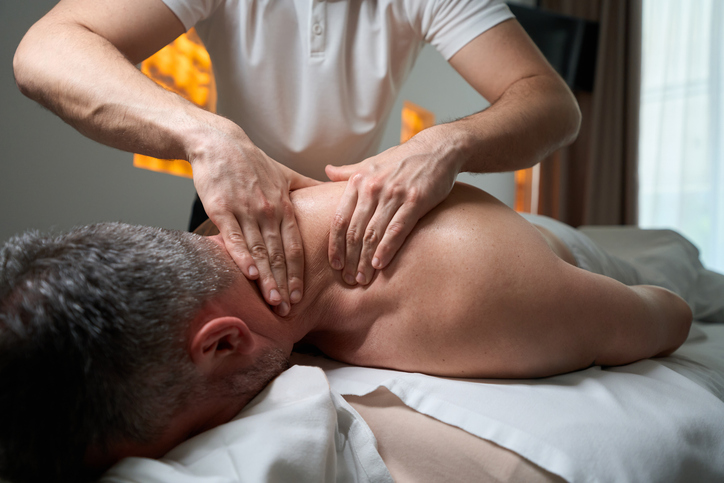
During a class I teach at a local massage school, I watched an earnest student struggle to get into the horse stance. It was painful to watch this frustrated student’s effort. It reminded me of the endless tossing and turning of a desperate insomniac looking for a position of rest (see Figure 1). She straightened her twisted knees, then her arches fell. She lifted her arches, then her thighs started to tremble. She shifted her thighs, then her back arched. So went the battle. Eventually, I interrupted her circular efforts with an offer of help, and she sighed with relief. I suggested that she stand up and relax, letting go of any effort to get it right or correct what was wrong. Once she relaxed, I proposed that she place her hands on her client with a calm, receptive touch in order to better connect. Then, when she was finally centered, I suggested she simply step forward and begin the massage (see Figure 2). The student was surprised that massage could feel so easy when given from a standing posture and expressed gratitude for this new option. She explained that her instructors insisted students use the horse stance, but lamented, “Our teachers keep stressing how important it is to stay relaxed in your body while giving a massage, but then they ask us to get into a stance that is uncomfortable and creates more tension.” Over the past 18 years, I have taught movement classes to hundreds of massage students and often hear similar sentiments. They remark how, in the horse stance, they can move the upper body OK, but the lower body is fixed. It becomes wide and immovable. As one student commented, “It is more like a sawhorse stance.” Their consistent struggles make me wonder why this stance is so widely taught and if there is a relationship between its widespread use and the high percentage of massage therapists who suffer repetitive-use injuries. The Horse Stance Many massage instructors teach the horse stance to center movement in the lower body and to emphasize the healing aspects of martial arts — being centered, taming aggression, blending with the client’s energies, and being grounded. Surely these are helpful traits, but is the horse stance the best way to develop effective body mechanics for the massage therapist? Martial arts and body mechanics are both broad and distinct subjects. Understanding body mechanics involves knowledge of joint range, muscle function, and postural analysis. These topics are studied in most massage programs so students will understand the underlying patterns of pain and injury that often bring people to massage therapy. Many schools also promote the philosophy of “healer, heal thyself” by having students study and improve their own postural patterns. The Horse Stance vs. the Human Stance The value of teaching the human stance as a basis for massage body mechanics is multidimensional. First of all, we will be teaching students a deeper embodiment of what they innately know — the dynamics of our uniquely upright posture. Optimal posture leads to effortless strength and grace that may not move mountains but will surely allow us to glide through session after session day after day. This innate vertical posture extends our legs and spine, suspending our physical bodies between heaven and earth, between rooting in our feet and reaching skyward with our perceptions. Standing upright is so natural that we only notice it when muscular spasms and chronic holding patterns grab our attention, pull us off-center, and force us to use excessive contraction. Some advocates of the horse stance would have us bend the knees and tuck the pelvis to correct these chronic tensions, yet repositioning merely bypasses the cause and can even exacerbate the symptoms. Our massage clients often seek massage for relief from the painful myofascial tensions that prevent comfortable sitting and standing. When these clients ask massage therapists about how best to sit, stand, stretch, and exercise, they are looking for tools that promote balance in their bodies. What they are really seeking is structural and functional integration — a return to the natural alignment and the spontaneous yet grounded movement abilities they had as children.3 Grounding We all have defenses. We need them to survive. They become problematic when they lock our bodies into habitual patterns that work to suppress unmanageable emotions and unresolved issues. Eventually we accept the tensions of these holding patterns as normal. Then, they become subconscious, wrapping our bodies like tight muscular outfits, restricting motion, degrading posture, and even leading to pain and injury. Holding patterns can be good for business (as illness and injury keep many a doctor busy) but they wreak havoc on practitioners. The muscular tensions inherent in holding patterns motivate many people to receive massage and make our businesses thrive. On the flip side, how miserable we are trying to help our clients let go of chronic tensions when we ourselves are in pain from our own bodily tensions. Fully embodying the human stance requires a release of holding patterns, both physical and psychological, which prevent us from standing in a truly upright posture. Without conscious release, we tend to carry holding patterns into all activities, including the horse stance. The Remarkable Efficiency of Upright Posture The horse stance requires not only more muscular exertion, it also increases joint compression. “The increase in muscle activity needed to maintain a flexed-knee posture subjects the tibiofemoral and patellofemoral joints ... and the hip and ankle joints to greater-than-normal compressive forces.”6 In activities that require controlled movement and dexterity, such as massage, it is more energy efficient and less compressive to begin in an extended posture. Gymnasts and divers do it, starting a routine from a neutral stance. And consider the typical posture when waiting in line at the grocery store or bank; are the knees flexed or straight? In a standing posture, the joints of the lower limbs and spine are extended, being neither flexed, hyperextended, nor rotated. Extension places weight-bearing joints in a neutral alignment that balances one major body mass over another — the head over the rib cage, over the pelvis, over the feet. When the body’s weight is balanced as close to the vertical axis as possible, the upright stance requires minimal energy to maintain, using less muscular activity from fewer and smaller muscles. This economy is achieved by the synergistic efforts of a small team of postural muscles working dynamically to continually rebalance the human body around its single vertical axis.7 The more aligned our bodies are in extension, the closer to home we live, so to speak. Positional vs. Dynamic Postural Education A dynamic approach to postural education is student-centered. It emphasizes self-awareness of full-body patterns. It recognizes the potential emotional and psychological roots of postural patterns and the importance of releasing those holding patterns before adopting new patterns. It cultivates fluidity in a dynamic rather than positional postural balance. And it emphasizes the training of postural muscle control (control meaning to be able to contract and relax postural muscles at will). A dynamic approach also gives a student privacy because Postural Sway and Fluidity Postural sway serves the bodyworker in a number of ways. First of all, sway is only possible in a fully extended posture. It is difficult to sway with bent knees, a tucked pelvis, or an arched back. Restrictions to a natural sway will highlight areas in our bodies that tend to lock or bend. Second, postural sway engages a subtle intrinsic motion that is relaxing. A practitioner can use postural sway to center and relax during the entire massage. Third, stiff posture usually translates to stiff touch, and vice versa. By giving massage from dynamic postural sway, both our movement and touch qualities are more fluid and relaxed, and our clients can feel the difference. Step into Massage with a Natural Gait When stepping, it is only natural to place one foot in front of the other, widening the base of support in the direction we are moving. By stepping into the massage from the human stance, we use what Rolfers call the rocker principle, giving ourselves a wide base of support from which to step backwards and forwards. We can then rock between the back and front foot in a movement similar to walking. Also, when we step forward, an important postural muscle along the spine, the multifidus muscle, reflexively contracts. Contraction of this postural muscle stabilizes the lower back, allowing the larger muscles of the spine to relax. It is the unnecessary contraction of the larger and more powerful spinal muscles that often underlie patterns of chronic back pain. Postural Muscles, Joint Stability, and Injury Prevention Stability training is spreading through rehabilitation programs where patients are learning to develop control of postural muscles in order to recover from injuries, to relieve chronic pain, and to improve motor control and athletic performance.9 Although this information is slowly seeping into the healing arts, particularly in Pilates and Rolfing education, it has yet to be widely integrated into massage education and practice. The value of learning postural muscle control is that the postural muscles stabilize our major weight-bearing joints, protecting them from pain and injury. In one study on postural muscles and low back pain, the researchers found that 87 percent of people suffering from chronic low back pain were unable to control the transversus abdominis muscle. Conversely, nearly all subjects without low back pain could and did consciously control this important postural stabilizer of the lumber spine (see Figure 7).10 A massage practitioner can gain several benefits from learning postural muscle control. First of all, the postural stabilizers have predominantly slow fibers that are fatigue-resistant. This means that if we use the right muscles for postural support, we will be able to work for long periods without the aches and pains of muscle fatigue. There is also evidence to show that when a person is in pain, the intrinsic postural muscles become inhibited.11 Conversely, facilitating the postural muscles allows the prime movers to relax, which can alleviate pain. Third, by training postural muscles, we can avoid injury from unstable joints and eliminate chronic pain due to poor posture. This, in turn, will allow us to work more efficiently and embody the postural balance and ease that we strive to create in our clients. To convert postural muscle education into practical table techniques for use with clients, you can have your clients lightly contract appropriate postural muscles while you stretch and release tight prime movers. This will not only make your work more effective, it will help to reduce or alleviate your client’s pain. It also provides clients with postural muscle reeducation and self-help tools, all with them lying on your table and you working in a relaxed, natural stance. As massage practitioners, we recognize how important it is to keep the fingers and wrists aligned to prevent repetitive-stress injury to the joints. Refining the human stance promotes optimal joint alignment along the spine and lower limbs. When aligned, more of our joints can absorb the stresses of pushing and pulling forces, which will protect any one joint from injury. From the aligned human stance, a practitioner can also press deep into the client’s tissues simply by shifting weight onto the front leg, just like a normal step in walking. The back leg behaves like the push-off leg in gait, dissipating the compressive forces along the line of extended joints between the hands and back foot. By stepping into the massage, it could be said that the energy of the earth flows up through the practitioner’s body into the client. This contrasts with the horse stance, where the idea is to sink into the earth rather than into the client. The human stance also places you over your work, which is only natural. Consider how you lean over pots and pans to scour them or stand over bread dough to knead it. Lowering the body’s weight into the horse stance places the body beside the client rather than over her. This works great for quadrupeds, like the horse that pulls a load in the same plane in which its equine spine is oriented. But as humans, we are oriented in the vertical plane. To move in synchrony with our vertical posture, we need to work from an upright posture rather than hunkering down into a flexed stance. Scope of Practice Practicing within this holistic paradigm could also help clear up murky issues around scope of practice that are widespread in the massage profession. Although our scope of practice limits a massage therapist from the evaluation and treatment of specific problems, many massage instructors are teaching orthopedic evaluations and manual therapy techniques that do just that. While these techniques may benefit clients as well as therapists, they also cause many medical practitioners to frown on the field of massage therapy because we are practicing outside of our scope. I propose that we promote the practice of manual therapy within a holistic and somatic paradigm, one based on the dynamic alignment of human posture and gait, one that cultivates the client’s somatic awareness of full-body movement patterns, and one that practitioners and teachers can embody as well. In this way, we will not only be practicing what we preach, but we will To conclude, as human beings we are blessed with the most efficient and effortless natural posture in the animal kingdom. The human stance is our birthright. We do not have to be taught it because its neuromuscular pathways run deep in our physiology. We need only remove the restrictions to standing fully upright and more fully embody our heritage. Why practice the horse stance when we can work in synchrony with the natural design of the human body? Why not teach and practice massage from a stance that is not only our most mechanically sound posture, but is also one we have all practiced from the day we first stood up? Mary Ann Foster has been a massage therapist and movement educator for 24 years and teaches movement classes at the Boulder College of Massage Therapy. Foster recently published Somatic Patterning, a sourcebook specifically for bodyworkers who want to integrate movement education into their practices. She can be reached at info@somaticpatterning.com. References
Share your thoughts! Click here to send a letter to the editor and let us know what you think. Your letter may be used in an upcoming issue of Massage & Bodywork magazine.
Please close window after reading. |
||||||||||||||
| ©2003 Associated Bodywork & Massage Professionals. All rights reserved. No portion of this website may be reproduced, stored in a retrieval system, or transmitted in any form by any means, electronic, mechanical, photocopying, recording, or otherwise, without prior written permission from ABMP. |